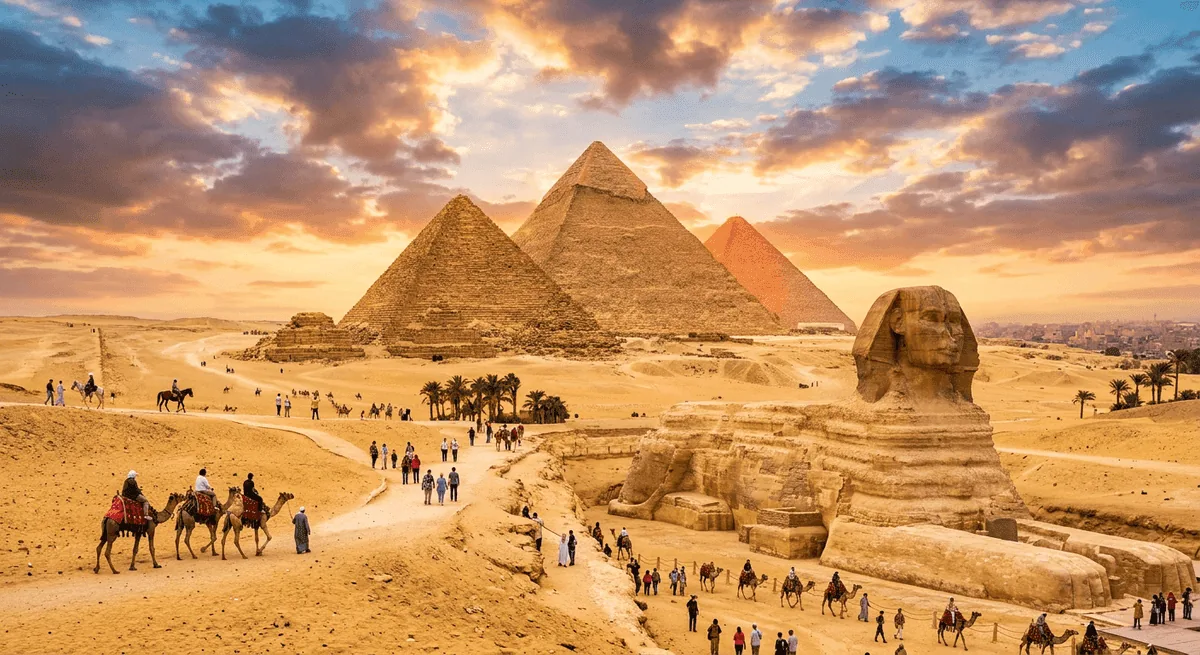
Pyramids of Giza Visitor Guide: Tickets, Timings, Scams & Sunrise Tips
Co-Founder & Operations Head, Trolly Good Fellow

What Most People Get Wrong About the Pyramids
I have stood at the base of the Great Pyramid more times than I can count — it is Day 2 of every itinerary in our Egypt tour packages from India — and the question I hear most is not about pharaohs. It is: "Were these really built by slaves?"
No. The slave story makes for good movies and bad history. Excavations on the Giza plateau have uncovered an entire workers' city — bakeries, breweries, medical facilities, and the tombs of the builders themselves, buried with honor within sight of the monument they raised. These were paid, skilled, rotating crews of Egyptian laborers and craftsmen, fed on bread and beer and proud enough of their work to scrawl team names like "Friends of Khufu" inside the relieving chambers. Nobody builds a tomb for a slave next to a king.
The second thing people get wrong: they picture the pyramids alone in an endless desert. In reality, the plateau sits on the edge of Giza city — stand at the Sphinx and you will see apartment blocks in one direction and open Sahara in the other. Frame your photos west and it is 2500 BC; turn around and there is a Pizza Hut. Knowing this in advance saves you the disappointment and, more importantly, tells you how to work the site: arrive early, walk deeper into the plateau than the tour buses go, and the ancient world opens up exactly the way you imagined it.
The Three Pyramids of Giza — Khufu, Khafre, Menkaure
Khufu — the Great Pyramid. Built around 2560 BC from roughly 2.3 million limestone blocks, it originally stood 146 metres tall and remained the tallest structure on Earth for nearly 4,000 years. It is the oldest of the Seven Wonders of the Ancient World and the only one still standing. Numbers do not prepare you for it: each ordinary block is about the weight of a small car, and the base covers 13 acres cut level to within a few centimetres. Whatever you think you know about ancient people, this building will revise it upward.
Khafre — the one that looks tallest. Khufu's son built his pyramid slightly smaller but placed it on higher bedrock, so from most angles it appears to dominate the plateau. It is also the most photogenic of the three, because the smooth white limestone casing that once covered all the pyramids still clings to its peak — that cap is your glimpse of how the entire plateau gleamed 4,500 years ago.
Menkaure — the small one with the expensive taste. At about 65 metres, it is a fraction of the size of the other two, but its lower courses were cased in Aswan granite hauled 900 kilometres down the Nile. Beside it stand three small queens' pyramids, which most visitors walk past and shouldn't.
Give the trio at least three unhurried hours. The plateau also holds mortuary temples, causeways, and the pits where Khufu's full-sized cedar solar boat lay buried for 4,500 years — the reassembled boat now lives at the Grand Egyptian Museum nearby, which pairs perfectly with an afternoon visit.
The Great Sphinx — Older Than the Pyramids?
Carved from a single outcrop of limestone bedrock, the Sphinx is 73 metres long, 20 metres high, and has been staring due east at every sunrise for about 4,500 years. Egyptology attributes it to Khafre — it sits beside his causeway and the face is generally read as his portrait.
Then there is the debate you have probably seen in documentaries: some geologists argue the weathering patterns on the Sphinx enclosure look like prolonged water erosion, which would push its origin back thousands of years before the pharaohs, into a wetter North Africa. Mainstream archaeology pushes back hard, and researchers keep probing the plateau with everything from seismic surveys to subsurface imaging. I am an operations man, not a geologist, so I will just say this: standing in the enclosure at 8 AM, before the crowds, the argument stops mattering. It is old enough.
Two practical notes. First, the nose: Napoleon's cannons are innocent — sketches show it was already missing centuries before he arrived. Second, you view the Sphinx from an enclosure terrace, not up close, and the classic "kissing the Sphinx" photo is taken from the panoramic ridge behind it. Your guide (or any of the twelve people who will offer) knows the exact spot.
Tickets, Timings & Getting There from Cairo in 2026
Tickets. General admission to the Giza plateau runs about ₹600 — genuinely one of the world's great travel bargains. Going inside the Great Pyramid is a separate ticket of roughly ₹1,500, sold in limited numbers per day, so buy it first thing if you want it. Interiors of Khafre or Menkaure cost less and open on rotation. Carry some cash; card machines exist but have moods.
Timings. The plateau opens between 7 and 8 AM depending on season and closes around 5 PM. The first hour is everything: soft gold light, cool air, and the site nearly to yourself. By 10:30 the tour-bus wave arrives and the temperature climbs with it. Our groups leave the hotel before sunrise precisely for this window — watching first light climb the Great Pyramid is a different experience from seeing it at noon behind three hundred buses.
Getting there. From central Cairo, an Uber costs ₹250-500 and takes 30-60 minutes depending on traffic — the honest, simple option. The budget route is Metro Line 2 to Sakiat Mekky, then a 15-minute taxi. If you are making a full day of it (Giza plus Saqqara plus Memphis), a private car with driver runs ₹2,000-4,000 for the day and is worth every rupee. On TGF trips all of this is prepaid and pre-timed, which is exactly the point of a group tour: the only decision you make at 6 AM is which pocket your phone goes in.
Inside the Great Pyramid — and the Sound and Light Show
Let me set expectations, because this is the most mis-sold experience at Giza. Inside the Great Pyramid there are no hieroglyphs, no treasure, no mummy. You enter through a robbers' tunnel, then climb the Grand Gallery — an 8.6-metre-high corbelled corridor that is one of the most astonishing spaces I have ever stood in — partly bent double through a passage barely a metre high, in air that is hot, humid, and shared with everyone breathing around you. At the top: the King's Chamber, a bare granite room with an empty sarcophagus.
And it is absolutely worth doing once. The engineering reads differently from the inside — fifty-tonne granite beams above your head, placed with precision we would struggle to match today. But skip it without guilt if you are claustrophobic, have knee or back trouble, or visit in summer. The pyramid does not get less impressive from the outside; some would say the opposite.
The evening Sound and Light Show is the other honest-review item. Colored floodlights on the pyramids, a booming narration by the Sphinx, unapologetically theatrical. It is cheesy — and oddly atmospheric, especially your first night in Egypt when the outline of the Great Pyramid against the dark still feels impossible. Ask about narration language options when booking; headset translations, including Hindi, have been offered. Verdict: watch it if you have a free Cairo evening, skip it without regret if you are choosing between this and sleep before a sunrise visit.
Photography Tips & the Scams to Sidestep
For the camera. The panoramic viewpoint on the desert ridge south-west of the plateau is where the classic all-three-pyramids shot lives — best at golden hour, when the limestone turns amber and camel silhouettes do half your work for you. Mid-morning, shoot the Sphinx from its enclosure terrace with Khafre rising behind. The forced-perspective clichés — pinching the pyramid tip, "leaning" on Khafre — need a phone, a patient friend, and no shame; every TGF group swears they won't and every TGF group does. For skyline drama, the Cairo Tower back in the city gives you pyramids floating over the metropolis on a clear day.
For the wallet. The scams at Giza are persistent but predictable. The camel ride quoted at "100" becomes 100 dollars, not pounds, at dismount — agree the full price, currency, and duration before anyone touches an animal, or simply book through your guide. A friendly local waves "that entrance is closed, come this way" — it isn't; keep walking to the official gate. Someone presses a "free" headscarf or trinket into your hands — nothing at Giza is free; hand it back with a smile. And anyone who starts explaining history uninvited will expect payment; a firm, cheerful "la shukran" (no thank you) is the most useful Arabic you will learn. On our departures an Egyptologist walks with the group, which converts all of the above from stress into background noise.
Beyond Giza — Memphis, Saqqara, Dahshur & How TGF Does It
If the pyramids grab you — and they will — the best half-day extension in Egypt is south of Giza. Saqqara holds the Step Pyramid of Djoser, built around 2670 BC: the world's oldest large stone building and the prototype every Giza pyramid descends from. Dahshur shows you the experiments — the Bent Pyramid, whose builders changed the angle mid-construction, and the Red Pyramid, the first true smooth-sided pyramid, which you can enter for a fraction of Giza's crowds. Memphis, the ancient capital, adds the colossal fallen statue of Ramses II and an alabaster sphinx. Seen in sequence, the three sites turn Giza from a picture into a story: you literally watch the pyramid being invented.
This is how we run it at Trolly Good Fellow: sunrise arrival at Giza, an expert Egyptologist, interior tickets pre-booked, photography time protected, scams handled before they reach you, and the Saqqara-Memphis extension built into our longer itineraries. Our Egypt group tours start at ₹24,444 for the 4-day Cairo Getaway — the most affordable way any Indian traveler can stand before the last surviving Wonder of the Ancient World — and the flagship 8-day tour (Pyramids, Luxor, White Desert) runs ₹98,000 all-inclusive. Message us on WhatsApp at +91 8557062245 with your dates, or browse the packages and blog itineraries below. The pyramids have waited 4,500 years; they will wait for your leave approval too.
Frequently Asked Questions
How much do Pyramids of Giza tickets cost in 2026?
General admission to the Giza plateau is about ₹600 per person. Entering the Great Pyramid of Khufu costs roughly ₹1,500 extra, sold in limited daily numbers — buy it at the gate first thing in the morning. Interiors of Khafre or Menkaure are cheaper and open on rotation. Carry some cash as backup for card machines. On TGF group tours, all entry tickets including the Great Pyramid interior are pre-booked and included.
Can you go inside the Great Pyramid, and is it worth it?
Yes. You climb through the Grand Gallery to the King's Chamber — a bare granite room with an empty sarcophagus. There are no hieroglyphs or treasures inside, the passages are cramped (about a metre high in places), and it gets hot and humid. It is still worth doing once for the engineering alone, but skip it guilt-free if you are claustrophobic or have knee or back trouble.
What is the best time to visit the pyramids?
Arrive when the plateau opens — between 7 and 8 AM depending on season. The first hour gives you soft light, cool air, and thin crowds before the tour-bus wave lands around 10:30. Seasonally, October to April is the window: 20-28°C daytime temperatures instead of the 40°C+ of summer. November and February are the sweet spots, and TGF runs its Egypt group departures only in this October-April season.
How do I get to the Pyramids of Giza from Cairo?
An Uber from central Cairo costs ₹250-500 and takes 30-60 minutes — the simplest option. On a budget, take Metro Line 2 to Sakiat Mekky and a 15-minute taxi from there. For a full day covering Giza, Saqqara, and Memphis, hire a private car with driver for ₹2,000-4,000. TGF group tours include all transfers with a sunrise-timed departure.
Is the Sound and Light Show at the pyramids worth it?
It is unapologetically cheesy — floodlit pyramids and a booming narration by the Sphinx — and also oddly atmospheric, especially on your first night in Egypt. Multiple narration languages are offered, with Hindi available via headsets. Watch it if you have a free Cairo evening; skip it without regret if it competes with sleep before a sunrise pyramid visit, which is the better experience of the two.
How much time do you need at the Pyramids of Giza?
A minimum of three unhurried hours covers the three pyramids, the Sphinx, and the panoramic viewpoint. Add the Great Pyramid interior and photography time and you have a half day. The ideal Cairo day is pyramids at sunrise, the Grand Egyptian Museum in the afternoon, and the optional Sound and Light Show at night — exactly how Day 2 of TGF's Egypt itineraries is structured.
Go deeper — month & package guides
Ready to explore Egypt?
Browse our handcrafted Egypt tour packages. Small groups, all-inclusive pricing, 5-star rated by 482+ travelers.