
Petra from India: The Complete Visitor Guide
Co-Founder & Operations Head, Trolly Good Fellow
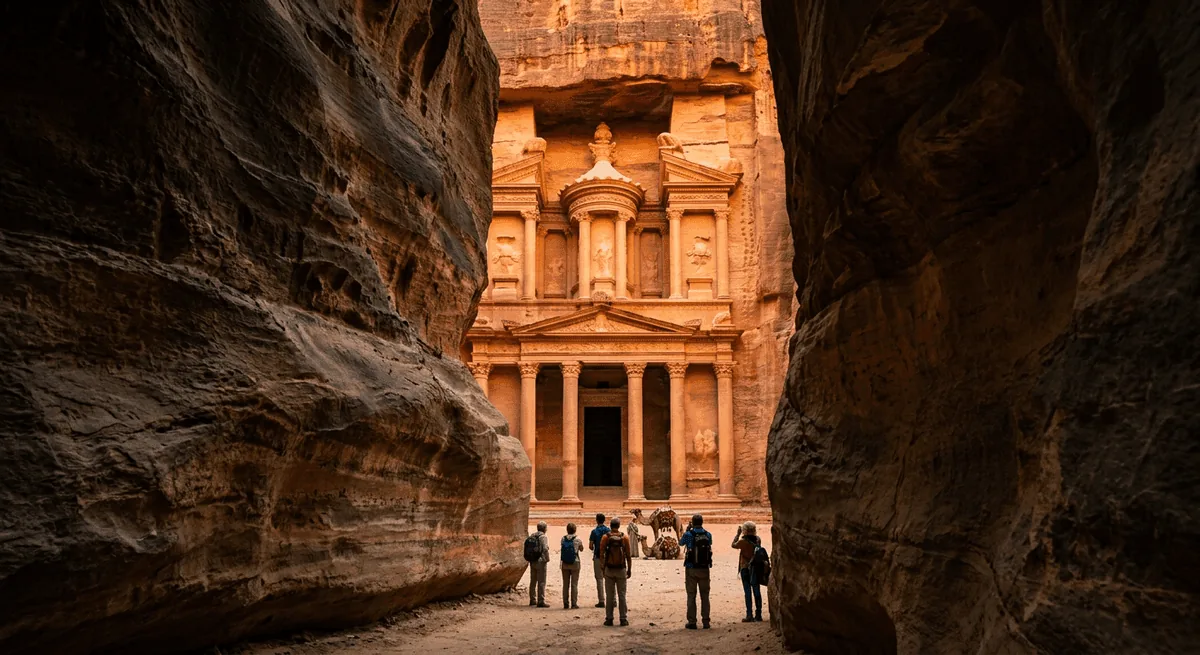
Every traveler who books our Jordan tour packages from India arrives picturing the same thing: one rose-colored building at the end of a canyon, hello Indiana Jones. Then they walk through the Siq, see the Treasury — and discover it is the front door, not the destination.
What Petra Actually Is — And Isn't
Petra is a city. A 264-square-kilometre archaeological city with more than 800 carved monuments, built by the Nabataeans — Arab traders who grew wealthy controlling the incense and spice routes between Arabia, Egypt, and the Mediterranean. From around the 4th century BC they carved their capital directly into rose-red sandstone cliffs: royal tombs, a 6,000-seat theatre, temples, banquet halls, and a water system of channels and cisterns clever enough to sustain tens of thousands of people in a desert. Settlement in this valley runs even deeper — prehistoric Beidha, just north, predates the Nabataeans by millennia.
And the Treasury itself? Almost certainly not a treasury. The name comes from a Bedouin legend that a pharaoh hid gold in the urn on its facade — the urn is solid stone, and the bullet scars from hopeful marksmen are still visible. It is most likely a royal tomb, probably for the Nabataean king Aretas IV. UNESCO listed Petra as a World Heritage Site in 1985, and it deserves the cliche attached to it: half as old as time, and twice as large as you expect. Plan accordingly — this guide shows you how.
How to Get to Petra from India
There are no direct flights from India to Jordan, but the one-stop routes are painless. From Mumbai, Delhi, and Bengaluru, you fly to Amman's Queen Alia International Airport via Doha, Dubai, Abu Dhabi, or Istanbul — total journey time of roughly 8-12 hours depending on the layover. Return fares typically run ₹30,000-50,000, cheapest in the March-May and September-November shoulder months, which conveniently are also the best months to visit.
From Amman, Petra is a drive south to the town of Wadi Musa — literally "Valley of Moses" — which exists almost entirely to host Petra's visitors. You have two road options. The Desert Highway is the fast one: a little over three hours, flat and featureless, perfect if Petra is your first stop. The King's Highway is the scenic one: five to six hours with stops, threading through Madaba's Byzantine mosaics, Mount Nebo, and the rim of Wadi Mujib — Jordan's Grand Canyon. On our group tours we typically go down one way and return the other, so you get both.
One operations note: do not plan Petra as a day trip from Amman. Seven hours of driving wrapped around Petra's 8-10 kilometres of walking is how you end up remembering your bus seat better than the Monastery. Sleep in Wadi Musa at least one night — ideally two.
Jordan Pass — The Smart Way to Save
If you remember one logistical tip from this guide, make it this: buy the Jordan Pass online before you fly. It is the single best-value document in Middle East travel.
Here is the math. A Jordan visa on arrival costs 40 JOD. A one-day Petra ticket costs 50 JOD, a two-day ticket 55 JOD. Bought separately, visa plus two Petra days is 95 JOD — roughly ₹11,500 at current exchange rates. The Jordan Pass bundles the visa waiver (valid if you stay at least 3 nights in Jordan, which you will) with Petra entry and access to 40+ other sites including Jerash and Wadi Rum. It comes in three tiers named for your Petra days: Jordan Wanderer (1 day, 70 JOD), Jordan Explorer (2 days, 75 JOD), and Jordan Expert (3 days, 80 JOD) — roughly ₹8,500-10,000. The Explorer pays for itself before you finish Day 1.
Three fine-print items travelers miss. The pass must be purchased before you arrive in Jordan for the visa waiver to apply. Petra by Night is a separate ticket and is not included. And the pass runs on consecutive days at Petra, so plan your two entries back to back. On TGF departures we handle Jordan Pass setup for every traveler as standard — it is the first thing our pre-departure checklist confirms.
How Many Days for Petra? A Two-Day Plan That Works
One day in Petra means seeing the highlights at a march. Two days means seeing Petra. Three days is for archaeology lovers who want Little Petra and the back trails. For most first-timers from India, two days is the honest answer, and here is the plan we run.
Day 1 — the Siq, the Treasury, and the Royal Tombs. Enter at 6-7 AM when the gate opens. The Siq is a 1.2-kilometre slot canyon that narrows and darkens until the Treasury appears through a final crack in the rock — I have watched dozens of groups hit that reveal, and the collective gasp never gets old. Continue past the Street of Facades to the 6,000-seat theatre, then climb to the Royal Tombs, whose sandstone interiors swirl in bands of rose, orange, and blue. Walk the colonnaded Roman-era street to Qasr al-Bint before looping back. That is a full, glorious, 8-10 kilometre day.
Day 2 — the Monastery and Petra by Night. Go deep into the site early and take on the climb to the Monastery (Ad-Deir): roughly 850 rock-cut steps, 45-60 minutes up. At the top waits a facade larger than the Treasury, shared with a fraction of the crowd, and a cafe with the best-earned tea in Jordan. Descend and exit by mid-afternoon to rest, because if your visit lands on a Monday, Wednesday, or Thursday, return at 8:30 PM for Petra by Night — the Siq and Treasury forecourt lit by 800 candles with Bedouin musicians playing. It is a separate ticket of about ₹2,000, unashamedly touristy, and completely magical. Sequence your trip to catch it.
Best Time to Visit Petra + Where to Stay in Wadi Musa
When to go. March-May and September-November are the windows: 20-30°C days, cold-free nights, ideal Monastery-climbing weather. Summer (June-August) pushes 35-40°C in a site with almost no shade — if you must, walk at dawn and surrender the afternoons. Winter is underrated (crisp light, thin crowds) but brings real rain risk: flash floods can close the Siq at short notice, which is why our fixed Jordan group departures run in the spring and autumn windows.
Where to stay. Wadi Musa is a one-industry town, and the industry is you. At the top end, the Movenpick Resort Petra sits directly opposite the visitor centre gate — you roll out of breakfast into the Siq; expect roughly ₹15,000-25,000 a night. The dependable mid-range pick is Petra Moon, a few minutes' walk from the gate, at around ₹6,000-9,000. On a budget, Cleopetra and its neighbours in the town centre run ₹2,500-4,000, honest and clean, a short taxi from the entrance.
The location calculus is simple: at 6 AM, when the gate opens and the light is gold, the difference between a 2-minute walk and a 15-minute taxi is the difference between having the Treasury nearly alone and sharing it. Book close if your budget allows, and book early for spring and autumn — the town genuinely sells out.
Photography Tips & Common Tourist Scams
For the camera. The Treasury sits in a canyon, so it gets direct sun only mid-morning — roughly 9-11 AM depending on season — when the facade glows rose-gold; at 6 AM you get soft, even shade and no crowds, which is its own kind of perfect. The famous view of the Treasury from above is accessed via official trails — go with a licensed guide, both for safety and because the unofficial "shortcut" routes are how tourists get hurt or fleeced. The Siq is best mid-morning when light shafts cut down between the walls, and the Monastery saves its show for late afternoon, when the sinking sun sets the facade on fire. Carry double the water you think you need; sandstone country is thirsty work.
For the wallet. Petra's hustles are gentler than Giza's but follow the same rules. The donkey or camel ride offered "for free, my friend" acquires a price at the far end — agree cost, currency, and distance before anyone mounts, or decline outright (the animals' welfare is an added reason to walk). Unofficial guides offering secret viewpoints are unlicensed and uninsured. The "genuine ancient coins" sold in the site are genuinely neither. And the Bedouin stallholders inside Petra are largely charming and fine to buy tea or souvenirs from — just bargain with a smile, as you would at home. On TGF trips a licensed local guide walks with the group, which retires the entire list above.
Visit Petra with TGF — Group Tour Advantages
You can absolutely do Petra independently — this guide gives you everything you need. Here is what a group departure adds, from the person who runs the operations behind them.
Sequencing, first. Petra rewards planning that most DIY trips discover too late: entering at gate-open, tackling the Monastery before the heat, and landing your visit on a Monday, Wednesday, or Thursday so Petra by Night is even possible. Our itineraries are built backwards from exactly these constraints. Second, a licensed Nabataean-history guide who turns 800 anonymous facades into a functioning ancient city — the difference between seeing Petra and understanding it. Third, the logistics disappear: Jordan Pass arranged before you fly, hotels walking distance from the gate, transfers timed, every entry pre-cleared.
Our Jordan group tours from India start at ₹51,604 for the 4-day Petra Peek — flights-included pricing on twin sharing, built around two full Petra days — and the 7-day Jordan Jewels Complete, at ₹99,522, adds Wadi Rum, the Dead Sea, and Jerash around the Petra core. Fixed group departures leave every Monday and Tuesday. A 30% advance confirms your seat, with EMI options available.
Message us on WhatsApp at +91 8557062245 with your dates, or browse the Jordan packages and the 14-day itinerary linked below. The Treasury has been waiting behind that crack in the rock for 2,000 years — the gasp is ready when you are.
Frequently Asked Questions
How do I reach Petra from India?
Fly from Mumbai, Delhi, or Bengaluru to Amman via Doha, Dubai, Abu Dhabi, or Istanbul — there are no direct India-Jordan flights, and return fares run roughly ₹30,000-50,000. From Amman, Petra is a little over three hours south by the Desert Highway (or 5-6 scenic hours via the King's Highway) to the town of Wadi Musa at the site's gate. Stay at least one night — Petra does not work as an Amman day trip.
How much does Petra entry cost, and is the Jordan Pass worth it?
A one-day Petra ticket is 50 JOD and a two-day ticket 55 JOD, while a Jordan visa on arrival costs 40 JOD. The Jordan Pass (70-80 JOD, roughly ₹8,500-10,000) bundles the visa waiver — valid if you stay 3+ nights in Jordan — with Petra entry and 40+ other sites including Jerash and Wadi Rum, so it pays for itself on your first Petra day. Buy it online before you fly; TGF arranges it for all travelers.
How many days do you need in Petra?
Two days is the honest answer for first-timers. Day 1 covers the Siq, Treasury, theatre, Royal Tombs, and the Roman colonnaded street; Day 2 adds the Monastery climb and, on the right night, Petra by Night. One day means rushing the highlights; three days suits archaeology lovers who want Little Petra and the back trails. TGF's 4-day Petra Peek tour is built around two full Petra days.
Is Petra by Night worth it?
Yes — with calibrated expectations. On Monday, Wednesday, and Thursday nights, the Siq and Treasury forecourt are lit by 800 candles while Bedouin musicians play. It is a separate ticket of about ₹2,000 (not covered by the Jordan Pass), it is openly touristy, and it is still one of the most atmospheric evenings in travel. Sequence your visit to land on one of those three nights.
When is the best time to visit Petra?
March-May and September-November: 20-30°C days that make the Siq walk and the 850-step Monastery climb genuinely pleasant. Summer hits 35-40°C on a site with almost no shade, and winter rains bring flash-flood risk that can close the Siq at short notice. TGF's fixed Jordan departures run every Monday and Tuesday in the spring and autumn windows.
How difficult is Petra for older travelers, and is the Monastery climb manageable?
Petra involves real walking — 8-10 km on a full day — but the main trail to the Treasury and Royal Tombs is flat and manageable at a gentle pace with rest stops. The Monastery adds roughly 850 rock-cut steps, 45-60 minutes up; fit seniors in our groups do it slowly and love it, and those who skip it still get a complete Petra day. Golf-cart transfers now operate on the main trail for those who need them.
Go deeper — month & package guides
Plan a trip around you
Explore our trips or speak with the team about your dates, budget and travel requirements.